
Indonesia's New Criminal Code: The Expansion of Corporate Criminal Liability and Governance Risks
Indonesia’s New Criminal Code introduces a new era of corporate criminal liability. Beyond corporations themselves, directors, commissioners, beneficial owners, and other controlling individuals may now face personal criminal exposure. This Legal Insight explores the implications for corporate governance, compliance, and risk management.
LEGAL INSIGHT
6/1/20262 min read
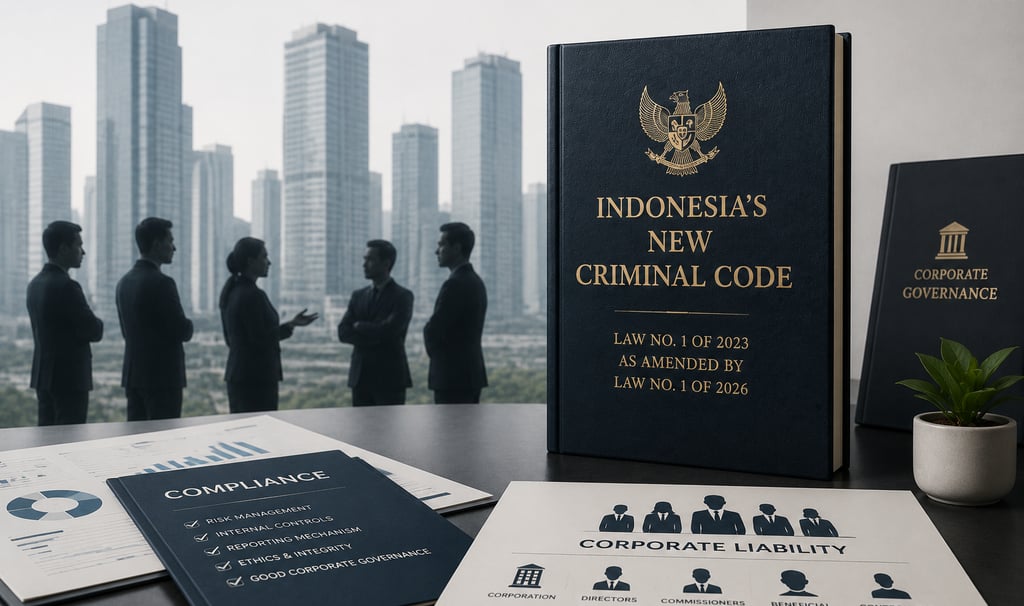
The enactment of Law No. 1 of 2023 on the Indonesian Criminal Code, as amended by Law No. 1 of 2026 on the Adjustment of Criminal Provisions (the “New ICC”), marks a significant development in Indonesia’s criminal law framework by expressly recognising corporations as subjects of criminal liability.
Under Article 49 paragraph (2) of the New ICC, criminal liability may be imposed not only on a corporation itself, but also on members of its management, individuals exercising control over the corporation, persons giving instructions, beneficial owners, and other individuals who hold functional positions within the corporation. This demonstrates that under the New ICC regime, liability for corporate crimes is no longer limited to the corporate entity itself, but may also extend to the individuals behind the corporation’s decision-making, supervision, and control.
To determine whether a criminal act may be attributed to a corporation, the New ICC establishes several requirements that must be satisfied. In principle, a corporation may be held criminally liable where a criminal act is committed for or on behalf of the corporation, for the benefit of the corporation, within the scope of the perpetrator’s duties or functions, or where the corporation fails to take necessary measures to prevent the occurrence of the criminal act.
Importantly, the New ICC significantly broadens the scope of criminal exposure within a corporate structure. Directors, commissioners, officers, beneficial owners, controlling persons, and other individuals who exercise authority, supervision, or influence over corporate activities may face personal criminal liability where the relevant legal requirements are fulfilled.
The recognition of corporations as criminally liable entities, coupled with the expansion of liability to both corporations and individuals within the corporate structure, underscores the growing importance of corporate compliance, risk management, and good corporate governance. Corporate compliance should no longer be viewed merely as a governance obligation, but as an essential mechanism for mitigating potential criminal liability.
In light of these developments, corporations should ensure that effective compliance programs, internal controls, reporting mechanisms, and governance frameworks are implemented and consistently maintained. Given that criminal liability may extend beyond those directly involved in decision-making to individuals who exercise control, supervision, or influence over corporate activities, a proactive compliance culture has become an essential component of corporate risk management in Indonesia.